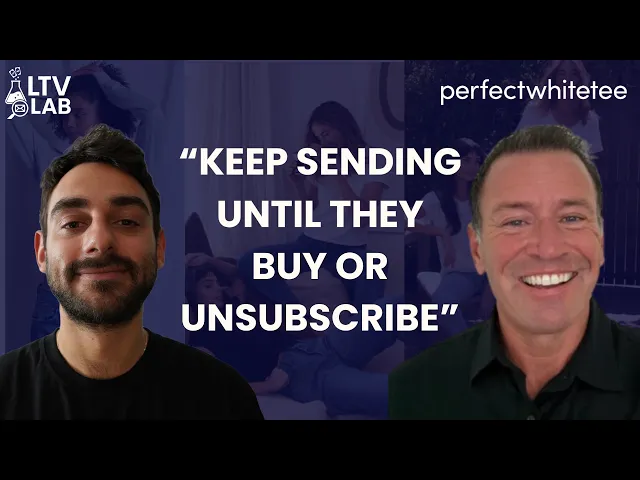
LTV LAB: We Bought from Perfect White Tee (Featuring CMO, Johnny Hickey)
Discover the full customer journey from site visit to unboxing with Perfect White Tee, and what can be improved to drive higher customer LTV in the future.
Brand Overview
Perfect White Tee is a premium basics brand specializing in high-quality, made-in-USA t-shirts and apparel. Founded in 2019 by co-founders with deep fashion industry experience (one co-founder previously built an 8-figure t-shirt company; the other sold hundreds of millions in apparel as a sales rep), the brand targets men and women ages 18-65 who value quality and are willing to invest in durable wardrobe staples. Products are priced at premium levels ($80+ for t-shirts, $148 for sweatshirts) and emphasize longevity—some pieces remain wearable after 4+ years. The brand differentiates through American manufacturing, 100% cotton materials, and thoughtful design details. CMO John Hickey is largely self-taught through marketing books, podcasts, and YouTube, bringing a performance-driven approach to lifecycle marketing.
Website Experience
First impressions: Visitors are immediately greeted with a zero-party data popup collecting preferences (tops, bottoms, dresses, loungewear) followed by email and SMS capture. The popup converts well but has compliance concerns—legal language appears below the CTA button rather than above it, creating potential lawsuit risk from ambulance-chasing lawyers.
Product navigation: The site is well-organized with clear collections and easy browsing. Product detail pages feature excellent information including honest disclaimers about slight color variances and a unique “sheer level slider” for transparency—an especially valuable feature for women’s clothing that helps guide purchasing decisions.
Naming convention challenges: Products use style names (Harley, Hendrix, Cheryl, Alanis) rather than descriptive labels. While the brand team knows these intimately (Harley = crewneck, Hendrix = V-neck), new customers may find this confusing. The website only recently added descriptors like “crewneck t-shirt” to product pages after customers landed on the site via Google searches expecting unrelated products.
Personalization touchpoints: Zero-party data is collected via popup and used within Klaviyo CDP to enrich profiles and inform segmentation, though opportunities exist to leverage this data more dynamically in flows and campaigns (especially in the welcome series).
Email & SMS Marketing
Acquisition flows: Welcome series sends two emails on day one—the first branded, the second in plain text. This aggressive approach aligns with the brand’s philosophy of pushing subscribers to either purchase or unsubscribe rather than remaining disengaged. However, zero-party data collected at signup isn’t being used to personalize welcome email content based on stated preferences.
Timing and cadence challenges: Perfect White Tee is known for high email frequency, driven by a “safety net” philosophy where email/SMS compensate for paid media spend. In the test purchase, 7 emails were received on day one (2 welcome emails, order confirmation from both Shopify and Klaviyo, post-purchase care email, and abandoned cart email)—creating potential for fatigue even among engaged customers.
Abandoned cart flow: Currently running 8 emails in the abandoned cart series with a philosophy that unsubscribe rates decrease with each subsequent email (first email: 0.50-0.70%, declining to 0.32% by email three). However, the flow lacks filters to exclude recent purchasers, resulting in customers receiving 6 abandoned cart emails after completing their order. Multiple compliance issues exist, including duplicate emails with identical creative (only subject lines differ) and false urgency language (“code expires in 24 hours” followed by “get 10% off for 48 hours” the next day).
Post-purchase communications: Order confirmations come from both Shopify and Klaviyo with similar content—the Klaviyo version was intended to replace Shopify’s but wasn’t properly disabled. A post-purchase care email about product maintenance was tested immediately after purchase as part of a “buy again same day” strategy, though this created excessive volume and was ultimately removed. The brand also tested a “last chance to add to your order” email offering 15% off and free shipping, but fulfillment challenges (orders shipping too quickly) led to its discontinuation.
Review requests: Review request emails feature real customer testimonials but lack names, verified purchase badges, or other trust signals that would make the social proof feel more authentic.
Copywriting & design: Emails lean heavily on product names (Harley, Hendrix, Cheryl) without descriptors, which may confuse new customers unfamiliar with the naming system. Some emails feature white text on white backgrounds or white products on white backgrounds, reducing readability. CTAs occasionally misalign with landing pages (e.g., “stay connected” linking to homepage rather than email preferences or social pages).
Unboxing & Product Experience
Packaging: While not extensively discussed in the transcript, the brand emphasizes product quality with durable, premium materials. T-shirts demonstrate exceptional longevity (4+ years of wearability while maintaining appearance).
Product education: Post-purchase flows include product care instructions, though timing could be optimized—sending care emails immediately after purchase (when 7 emails have already been received) reduces impact and opens.
What Works Well
Strong zero-party data collection driving segmentation
Excellent product detail pages with honest disclaimers and practical tools (sheer level slider)
High-quality, durable products that justify premium pricing
Aggressive email strategy that treats lifecycle channels as performance marketing levers
Plain text emails in welcome series drive engagement
Strategic use of real customer reviews in marketing
Well-organized site navigation and product browsing
Opportunities for Higher LTV
Fix compliance issues immediately: Move legal language above CTA buttons in popups, remove false urgency language from abandoned cart emails, stop promoting discontinued loyalty program
Implement proper flow filters: Exclude recent purchasers from abandoned cart flows to prevent irrelevant messaging
Optimize post-purchase timing: Space out post-purchase emails to avoid 7 emails in one day—send product care instructions later in the journey when they’ll be more impactful
Leverage zero-party data dynamically: Use popup responses to personalize welcome email content and product recommendations from the first touchpoint
Consolidate transactional emails: Disable duplicate order and shipping confirmations from Shopify since branded Klaviyo versions exist
Add context to product names: Include brief descriptors (crewneck vs. V-neck) in emails to help new customers navigate the product line
Test abandoned cart creative variations: Move beyond duplicate emails with different subject lines—introduce new angles around value propositions like made-in-USA quality, durability, and materials
Enhance review social proof: Add customer names and “verified purchase” badges to review content in emails
Improve CTA-landing page alignment: Ensure email CTAs lead to relevant destinations rather than generic homepage links
Optimize for mobile readability: Fix white-on-white text issues and improve contrast throughout email templates

