LTV LAB: We Bought from Little Trouble (Featuring CEO, Dinah Chapman)
Discover the full customer journey from site visit to unboxing with Little Trouble, and what can be improved to drive higher customer LTV in the future.
Brand Overview
Little Trouble is a 3.5-year-old kids’ apparel brand founded by Dina Chapman, who built the business from an Etsy side hustle during maternity leave into a thriving DTC brand generating six-figure days. The brand fills a gap in the market for edgy, alternative kids’ clothing with exceptional quality: think “shrinking your husband’s wardrobe down” for toddlers and kids. Dina, who has 13 years of e-commerce experience scaling brands from six to eight figures, runs Little Trouble as a one-person marketing team while managing everything from design to customer service.
Customer Demo
Millennial parents (especially boy moms) who love action sports, moto culture, and alternative style: people who find traditional kids’ clothing boring and want their kids’ wardrobes to reflect their own aesthetic.
How Little Trouble Currently Looks at the Role Email & SMS Marketing Play to Fuel the Brand’s Growth
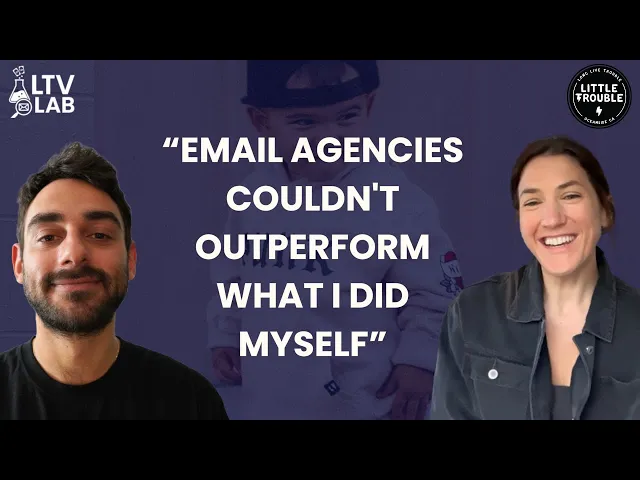
“I’ve been burned twice by email agencies that couldn’t outperform what I was doing myself,” Dina shared. Email has historically been a bandwidth bottleneck, focused mainly on launches, restocks, and conversion-driven campaigns with minimal nurturing, though that’s changing as the brand scales.
The On-Site Shopping Experience
Little Trouble’s website delivers an extremely smooth shopping experience with strong branding throughout. The product photography is exceptional: somehow capturing toddlers with the exact expressions needed to sell clothes (seriously impressive). We encountered some technical quirks during checkout: the Rebuy cart drawer didn’t load properly in Canada, defaulting to a native cart page without cross-sell widgets. The site is undergoing a complete redesign to address speed and functionality issues after three and a half years on the same theme.
Emails We Received Post-Purchase
Here’s what we experienced as real customers: Little Trouble nails one of the the hardest parts of email marketing. The creative is exceptional, the brand voice is perfectly consistent, and the product-focused campaigns clearly drive results. What’s missing is the connective tissue: the post-purchase nurturing that turns first-time buyers into repeat customers.
Dina runs marketing solo while managing design, manufacturing, and customer service. As she put it: “I mostly do launches, restocks, very intentional conversion-driven emails, but very little on the nurturing end.” This is the classic founder bandwidth challenge, and it shows up in predictable ways.
We uncovered one technical issue: the Yotpo loyalty program welcome email had no functioning links. The CTAs didn’t go anywhere, and the logo accidentally linked to a different company’s portal. “I am shocked,” Dina said when we showed her. Beyond the technical fix, there’s a bigger opportunity around post-purchase education:
We bought plaid flannel cargos but never learned about the full catalog (t-shirts, long sleeves, button-ups, mechanic suits, rompers, backpacks, hats, baby clothes, adult matching pieces)
No reminders about loyalty points earned or how to redeem them
No cross-sell emails in that critical 72-hour window when buying intent is highest
During the two-week BFCM sale, emails focused purely on discount messaging rather than giving customers content-driven reasons to shop (winter capsule wardrobes, gifting bundles, sibling sets, urgency around sizes selling out)
Black Friday launched without teaser emails, so it wasn’t clear this was the year’s best sale
Spend threshold offers (2X the AOV) weren’t clearly explained, and free gifts had no images or value statements
Dina was strategic about some of these choices: “We had really solid full-price days leading up to Black Friday and didn’t want to hinder those by teasing the sale. The sale was two weeks long, so people had time to marinate.” Fair reasoning, though the trade-off is that email subscribers didn’t get the same context her engaged Instagram followers received about sale duration and strategy.
“We acquired over 8,000 new customers during Black Friday,” Dina shared. “Now I’m looking at email as a retention play because we have a much broader list and a different person on it that I do have to nurture.” The timing is perfect: the creative foundation is already exceptional. Now it’s about building the systematic communication that helps new customers discover the full brand.
Unboxing & Product Experience
The product arrived in a branded poly bag with flame graphics and “Smile, Rad Clothes Inside” messaging: an immediately recognizable package that elevated the brand before we even opened it. Inside: exceptional quality clothing plus a sticker sheet that kids go wild for (parents post about them constantly, creating walking advertisements on water bottles, helmets, and skateboards).
What Little Trouble is Doing Well
Exceptional product quality and design that actually fills a market gap for alternative kids’ style
Branded packaging that creates an elevated unboxing experience without excessive cost (poly bags with custom graphics, sticker sheets that kids love and parents post about)
Outstanding creative and photography across all marketing channels with perfect brand voice consistency
Organic social strategy that built a loyal community of 350,000+ followers before heavy paid investment
Strategic BFCM execution including new product drops throughout the sale period to maintain engagement
Opportunities to Drive Higher LTV
Fix technical issues immediately: broken emails cost real revenue. The loyalty program welcome email had no working links except the logo, which went to a different company’s portal. Canadian customers weren’t receiving SMS or seeing popups. “How crazy,” Dina said when she realized thousands received broken emails. Use external QA (team members, friends, test accounts in different regions) before any email goes live.
Cross-sell aggressively in the first 72 hours post-purchase. Apparel buyers have their wallets out and are most receptive to additional purchases before receiving their first order. For Little Trouble’s extensive catalog (overalls, mechanic suits, button-ups, rompers, hats, matching adult pieces), we saw zero dedicated cross-sell communication. A/B test immediate post-purchase flows versus waiting until after delivery.
Give customers reasons to buy beyond discounts during promotional periods. During BFCM, every email said “25% off” but never explained why to shop now: “Build your child’s winter capsule in one go,” “Gifting made easy with curated holiday sets,” “Your kiddo is growing fast—update their closet all at once,” “Last chance before sizes sell out for the season.” Generic discount fatigue is real. Content-driven urgency converts better than repeated price messaging.
Make loyalty program benefits crystal clear in the welcome email. Show exactly how to earn points, what they’re worth, and what they can be redeemed for: without requiring customers to visit a portal. The current email is just “login” CTAs. For Little Trouble, include: “You just earned 25 points. Here’s how to earn more: $1 = 1 point, review a product for 50 points. Redeem for: 100 points = $5 off, 500 points = free shipping.”
Use dynamic content blocks to show relevant loyalty information based on customer status. Campaign emails showed “Sign up to start earning rewards” to customers already in the loyalty program. Instead, show enrolled customers their current point balance and redemption options. This requires minimal Klaviyo setup but dramatically improves relevance.
Educate customers about your full product catalog through dedicated post-purchase flows. We bought pants but never learned about Little Trouble’s t-shirts, long sleeves, shorts, button-ups, mechanic suits, rompers, backpacks, hats, baby clothes, or adult matching pieces. Founders assume “it’s on the website” but customers don’t browse: they need intentional education: “Since you loved the cargos, meet our 5-star mechanic suits” or “Complete the look: Our bestselling graphic tees.”
Leverage SMS for high-value moments only: new drops, promotions, and critical flow emails. Little Trouble sent SMS every other day during BFCM but many subscribers (including us in Canada) never received them due to technical issues. SMS works for 100% open rate moments (new product launches, flash sales, abandoned cart) but loses profitability fast with general campaigns. Grow the list, test thoroughly across regions, and deploy strategically.
Build pre-launch hype for major sales and product drops to maximize first-day revenue. Black Friday launched without warning, making it unclear this was the year’s best deal. Dina’s reasoning: “We had strong full-price days leading up and didn’t want to hinder those sales.” But teaser content doesn’t cannibalize if framed right: “Something big drops November 17th. Start your wishlist now. First access goes to our VIPs.” Pre-hyped launches consistently outperform surprise drops.
Add visual context and clear value to promotional offers. BFCM offered “Free water bottle at $150, free mom tote at $250” but showed no images or stated value. Customers couldn’t visualize what they’d receive or why it mattered. For any spend threshold offer, show the product and assign value: “Free titanium water bottle (retail $25 value)” with an image. Redemption rates jump when gifts feel tangible and valuable.
Test plain text emails for critical founder messages to improve deliverability. Dina almost sent a pure plain text BFCM email but added branding last minute: “I got so many fake founder emails that were plain text…I didn’t want it to feel icky.” But pure plain text (no logo, no formatting) achieves higher open rates and click rates because it looks personal and avoids promotional tabs. A/B test for critical moments: “Hey [First Name], Dina here. I wanted to give you one last heads up before our sale ends…”

